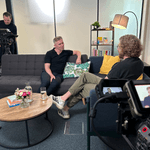
Summary of the Interview
This interview features Nicky Danino, Head of the School of Computing and Creative Industries at Leeds Trinity University, in conversation with David Savage, Tech Evangelist at Harvey Nash. Together, they explore the evolving relationship between AI, skills development, education, and the future workforce.
The discussion opens with Nicky describing her unique role overseeing both technical and creative disciplines, positioning her at the intersection of two sectors being rapidly reshaped by AI. This theme of creativity meeting technology runs throughout the conversation.
A major focus is the AI skills gap, particularly the unrealistic expectation that complex technical capabilities can be taught quickly or uniformly. Nicky emphasises that confidence, foundational understanding, and adaptability matter far more than learning a specific programming language or tool. She uses the metaphor of a Formula One team to highlight the different levels of AI capability society needs: many confident “drivers” and a smaller group of deep technical specialists.
They also explore the disconnect between universities and industry, noting that universities are not training centres for businesses, yet businesses often expect graduates to arrive job-ready with specific AI skills. Nicky argues for stronger collaboration, shared responsibility, and potentially even a “graduate finishing school” to bridge the gap.
Another key theme is the ethical and responsible use of AI. Nicky stresses that while AI can support many tasks, only humans can take responsibility for decisions, understand context, or ensure technology is used for good rather than harm. Leeds Trinity embeds responsible computing across its programmes and is actively working to integrate AI awareness into every discipline, not just computer science.
The conversation also touches on the regional opportunity for Leeds as an aspiring AI growth zone, the risk of reducing entry level roles due to automation, and the broader societal challenge of ensuring AI does not deepen digital divides or reduce diversity in the workforce.
Students’ perspectives are also discussed. Nicky notes that today’s students are more career-driven, yet different groups experience AI very differently. Younger students tend to be enthusiastic and curious, whereas mature students may worry about whether they have the right skills or confidence to succeed in an AI driven workplace.
Key Themes Discussed
- The growing AI skills gap and the need for foundational understanding over narrow technical skills.
- The balance between creativity and technology, and how AI is reshaping both.
- Industry expectations vs educational realities, and the need for a shared approach to skills development.
- Risks of automation, including fewer entry level roles and potential widening of the digital divide.
- Regional economic opportunities, particularly Leeds’ ambition to become an AI growth zone.
- Ethics and responsible computing, ensuring graduates understand societal impact, not just technical application.
- How universities embed AI across all disciplines, not only technical subjects.
- Student attitudes toward AI, including the concerns of mature learners.
Tech Flix Documentary
This interview forms part of Harvey Nash’s latest Tech Flix documentary, which explores the AI paradox: AI is scaling, skills are not. The film investigates how AI is transforming work, education, and regional economies, while asking a fundamental question:
Are we preparing people for the future, or leaving them behind?
Watch the latest Tech Flix here.
Full Transcript
David Savage 00:00
Thanks for your time this morning. Before we get into anything else, tell me a little bit about your role here at the university.
Nicky Daninio 00:05
So I'm head of School of Computing and Creative Industries, which means I look after subjects such as computer science, film, photography, journalism, English, media, games design.
David Savage 00:17
It is that really interesting intersection between creativity and technical within your role. You know, you mentioned photography and then computer science.That must be really interesting because that creative aspect or I suppose what AI is doing to creative industries is such a hot topic of conversation right now for so many people.
Nicky Daninio 00:36
It's a fantastic nexus to be at, especially because this is on the horizon for the government as well. So they're talking about AI, they're talking about creative industries, they're talking about different ways of doing things, so yes, it's a wonderful place to be.
David Savage 00:52
The government thinks that you can close the gap on the lack of AI skills between a 55-year-old and a 35-year-old in two and a half hours. I know that foundational skills are really important.I think that's what they're trying to close, that foundational gap. But when you hear government say something like that, to me it feels, it doesn't feel like we turn off people in industry who will hear that and go, that's not going to be adequate, that's not going to upskill people in the way that we need it to be able to do so. What do you think when you hear someone say, we can close the skills gap between a 55-year-old and a 35-year-old in two and a half hours?
Nicky Daninio 01:37
I think it very much depends on the person. It does sound very much like a broad brush, but technical skills are so much about confidence. Confidence is half the battle.If you have confidence and you try things out and you don't give up, you're tenacious, so do something. And if it doesn't work, try it again and see what happens. So it's very much done to the individual, but I can see what they're trying to do. They're trying to do something, which is better than doing nothing, isn't it?
David Savage 02:03
We're here because we want to talk about AI skills, in terms of the topic of conversation in industry at the moment. Obviously you're talking to the next generation of workers.When we talk about AI skills, how would you frame them or reference what AI skills are?
Nicky Daninio 02:20
So AI is really interesting because, of course, we've got the specialists, the computer scientists, a lot of them might be doing a degree with a specialism in AI. But what you're talking about is actually the entire population, aren't you, and bringing everybody up almost in the same way when 20, 30 years ago we were trying to get everybody to be able to use email on the internet.So now we're talking about AI.
2 mins 44
So to me, AI, we need to split it into different categories and think of a Formula One car. We've got some people who are really, really good at driving. You know, we've got Vandal Norris, Ashtappen, et cetera, they're amazing drivers. And we've got the team who's really good at making sure that the car works and knowing what goes on under the hood. And I think that's the differentiation we want to make.We need to make everybody into drivers, but obviously there's only going to be a small sect of the population who will be able to go under the hood and know what's going on.
David Savage 03:16
You know, everyone knows how to use their phone, they don't necessarily understand how their phone actually works if you were to break it down.
Nicky Daninio 03:22
Don't take a screwdriver to your phone, you'll probably break it.
David Savage 03:25
We talk very broadly about AI skills. Do you think there's a lack of understanding within industry itself about what those AI skills are?
Nicky Daninio 03:32
I think there's definitely a lack of understanding in industry about what we actually need people to be able to do and what we need people to know. So there's also a lack of cohesiveness, there's a lot of things going on in pockets, so certain bodies and industrial professional bodies, for example, are trying to get together, coming up with guidance, etc.But we definitely need more direction from the government and more leadership just or from someone so that we can just bring everybody together so we're all singing from the same hymn sheet.
David Savage 04:05
In your role, do you spend much time talking to industry or does industry approach the university in terms of trying to outline what it's looking for from people when they're coming into jobs?
Nicky Daninio 04:14
We spend a lot of time, at least, talking to industry. That doesn't mean we couldn't spend more.It's important to remember though that universities are not training centres for businesses. No. It's all about helping people reach maturity, creating graduates who are good problem solvers, who are critical thinkers. It's always important, I think, to separate those technical skills from the more holistic skills. Obviously, we need to train computing students or journalism students to be technical and to be able to work in that role, but there's more to it than that. And of course, technical skills change all the time and it's really difficult to keep up with them. So it's far more important to create that foundational sea of knowledge that they can then build on and become modular and be able to adapt to whatever circumstances that they face in the workplace.
David Savage 05:04
Something I want to pick out is this blend of technology and creativity certainly that sits within your role. One of the often said things about tech and AI in particular at the moment is that it will free people to spend more time on aspects of their role that they enjoy by taking away the mundane tasks that are inherently involved within their jobs.I was talking to someone yesterday who gave me the example of a translator that they know and it was a real world example. And the creativity within a translator's role was actually in the translation itself. And their job would become more mundane because effectively they'd ended up editing an AI translation rather than doing the translation themselves. I suppose my question is trying to pull at this thread that we're a little bit obsessed with the functional aspect of our jobs and that might not necessarily be the best thing for the person when we're talking about AI skills. Are we getting that balanced right in terms of how we think about skills and how we think about the future of our roles within organizations?
Nicky Daninio 06:16
I don't think we're getting the balance right, but it's fantastic that we're actually thinking about the balance and the fact that we need to consider it. So I'm a polyglot myself, and I know that translation is not black and white, especially when it comes to the English language.I didn't learn English till I was five, and it took me quite a while to get my head round sarcasm, for example. So I haven't yet seen any translation that doesn't need human input, but maybe that will come.
David Savage 06:44
Leeds is a region that aspires to be an AI growth zone. First of all, what do you think AI could do for a city and a region like Leeds and its people?
Nicky Daninio 06:56
I think if we get to that place where we can call ourselves an AI growth zone, and I think we're pretty close already, it would be really fantastic for the region. It will mean that we'll get the attention of big businesses, they'll want to come and situate themselves in leads, we're looking at more economic growth, but also we're looking at diversity and I think that's really important, getting lots of people into a city so that we're already a really diverse city anyway, but you can never be too diverse.It brings lots of different thinking together, lots more opportunities and actually it just makes it a more vibrant, fun and interesting place to live and work in as well.
David Savage 07:35
But do you think it generates real opportunity for people who are in the city, in the region already, and particularly around what we're talking about here, around kind of making sure that they have the right skills to thrive in industry?
Nicky Daninio 07:49
I think it will create opportunities for people and this is really strange coming from a computer scientist. Technology is not always the answer to everything and I think we need to keep that in the back of our heads that not everybody will want to make use of AI in their business.It's about making sure that we've got the right tool for the right job, right time, right place.
David Savage 08:09
At the minute, a lot of organisations aren't investing in their staff. If you look at the statistics, less than half the organisations that we surveyed are actively trying to upskill their professionals, their people around AI.Why do you think that is?
Nicky Daninio 08:24
there's a lot of factors. I imagine not everybody has prioritized their funding to do so.It's really important that when a business takes on a graduate they realize that the learning hasn't ended, it's only just starting actually. So it's about investing in that person. We all know that once you've hired somebody if you invest in them they'll stay with you, they'll add value to the business, they'll become a really important part of your company. So if they're not doing it they should be doing it so they need to rethink their priorities.
David Savage 08:53
Are you concerned that one of the unintended consequences of this focus on AI is that there are simply fewer opportunities for people at an entry level within most organisations?
Nicky Daninio 09:03
I think it depends on the industry. Certainly in computer science we're now seeing a little bit of a push towards, oh we don't need to hire an entry-level programmer because AI can do the programming for us. But that's a really, I think it's really short-sighted and it's really risky.There's nobody then to check that AI is doing it properly. And you know computer scientists are not just programmers, we're problem solvers, we're critical thinkers, we're designers, we're systems analysts. So there's more to it than just getting a machine to come and write some code for you.
David Savage 09:39
To your earlier point about an F1 team, could it lead to the point where we simply don't have the specialised engineers who understand how the car works?
Nicky Daninio 09:49
Sure, and at that stage, we might as well just get over the driver. We've already got self-driving cars, don't we? So why do we need the drivers? It will make for a very boring watch of an F1 race because everybody will... It'll be so former lake because everybody will do exactly the same thing.And we can apply that to business as well. Some of the more successful businesses have taken risks. They've been really creative. They've come up with new ways of doing things. And if we use technology to do that, we will get former lake results, won't we?
David Savage 10:18
I think what you're teasing out there is quite interesting. You could end up with a lot of quite low-level roles that are quite uninteresting and one or two very highly specialized roles for a few individuals.Does that risk exacerbating a digital divide?
10 mins 33
You talked earlier about the need for diversity, for a diversity of thought, diversity of different peoples. If we shrink down the number of roles available, that might harm that ability to bring diverse people together.
Nicky Daninio 10:49
You're completely right and I think that risk is there and we need to identify it now and make sure it doesn't happen because in the long term I'm not sure it's wise.
10 mins 57
We really need to talk about things like taking responsibility for technology and for decisions.For example, AI making decisions is not a human being taking responsibility. So one of the things that we embed within all of our computing courses is the concept of responsible computing. Take responsibility for anything you do, think about any software that you produce and what outcome that's going to have, not just on the output, which is very black and white, but on the wider society, are you producing tech for good or are you producing tech for harm? All of that, that concept of responsibility is never going to be taken on by a piece of AI, it has to be done by a human being.
David Savage 11:38
You're trying to make sure that people have the skills to thrive in the outside world beyond their studies. The outside world is moving at breakneck pace. The skills that we teach today are unlikely to be the skills that people need in five or ten years.How does an institution like this meet that challenge and make sure that people do have the right skill set tools available to them to thrive?
Nicky Daninio 12:04
So Dave, if I asked you to hazard a guess at how many programming languages exist, what would you tell me?
David Savage 12:12
Horribly out, it would show my ignorance. I would imagine it's in the thousands, but I don't know.
Nicky Daninio 12:16
I don't know either actually, I have no idea, but there's definitely at least hundreds. So it would be impossible to take a software engineering student and teach them all the languages they need to do to be able to then go into a business and successfully programming whatever language they're using without any additional support or training.So one of the things that we do is we try not to teach specific skills like A programming language. We give students the foundational knowledge of how to do something. So for example, if you're sorting data using a programming language, rather than teaching them how a specific language works, you teach them the concepts behind that sorting so that hopefully they'll be able to then take that knowledge and reapply it to whatever language the business is using.
David Savage 13:02
So you're teaching foundational knowledge. Businesses aren't picking up the mantle and teaching specifics because they're not exactly sure what they should be teaching.So the emphasis falls very heavily on the individual to make sure that they have the right skills that they need to succeed in their career, right?
Nicky Daninio 13:22
It's a lot of responsibility to place on a 20, 21 year old. I think that what it sounds like is there's a gap, isn't there, between universities and what universities can realistically do and expectations from business.Sounds like we need some kind of graduate finishing school. But yeah, the responsibility and the honest needs to be shared between all of us in order to achieve that AI ready graduate.
David Savage 13:50
How front and center is it for the thinking of your students here today? You know, they're obviously aware of AI in the workplace.And I ask that with the I suppose the context that when I was at university, I had very little idea of actually what I wanted to do after university. I think you're very much in the moment, but I would be surprised that they weren't slightly more aware than I was, say, 20 years ago.
Nicky Daninio 14:17
I think things have changed since we were both at university. It was almost, we're going to go to university because I really like the subject or that sounds really interesting.Students are a lot more savvy now when they come to university, even before they even apply they're looking at what kind of jobs can I get once I graduate, what's the content of the course, what type of salary would I be expecting in that role. So they do think a lot more about the whole journey whereas previously, you talk about 20 years ago it was probably just about that first leap wasn't it.
David Savage 14:49
And in this conversation, certainly at an industry level, the emphasis is very much placed on the needs of the business. I would imagine that here, obviously, that lens is through the needs of the individual.How do we make sure that businesses adopt something, I suppose, of the attitude and ethical responsibility of a university? Is that possible for them to think more about the individual than they currently do, where it is so through the lens of the bottom line, productivity, efficiencies, profits, rather than the overall well-being of an individual?
Nicky Daninio 15:28
historically the easiest and most straightforward way to make businesses do anything is through legislation. However, that's always going to undercut SMEs, for example, who maybe are not able to achieve that level of adherence to that legislation that they need to.If, for example, we say you need to have X number of hours, everybody needs to be trained on AI or on tech, but legislation always seems to be what has been done in the past. I think we underestimate how much students and graduates want to do a good job. They don't come to university and want to fail, they want to do well, they want to learn, and they want to then go and get a job and be a shining example of an employee. That's generally what a student does want to do, so we need to have a think about how we can help them achieve that.Everybody right now generally is sort of digitally savvy to some extent, but they might not know much about prompt engineering, they might not have heard of AI aside from chat GPT, for example, which is the only one most people have heard of, but they're not quite sure what to do with it. What we did 20-30 years ago to get people up to that basic digital skills level, we now need to do it again with AI, and it won't be an ongoing problem because in another 20 or 30 years everybody will be using AI just like people use their phones now. It'll be integrated into our lifestyle.
David Savage 16:52
If legislation and or regulation is the way to get businesses to listen and to respond and to think differently, how concerned should we be that government seems reticent to step in and to legislate? Certainly if you look at the United States, it's innovation at all costs, and that means very much on the side of business.The UK would appear to be very much going for a Goldilocks approach of a little bit of legislation but not too much. That would suggest that unfortunately the needs of the business are always going to be placed ahead of the needs of the individual.
Nicky Daninio 17:32
Generally, we know that a carrot works better than a stick. So I'm not sure that going the way of the US is the answer for us. It might also have a very deep impact on higher education in the UK, which is still regarded as being one of the best in the world. So it's a difficult question to answer.It's about finding that middle ground, isn't it? Maybe we need to have a think about how we can make it so attractive to businesses that they cannot not invest in people and make sure that they're all AI savvy because it makes really good business sense to do so.
David Savage 18:02
Obviously, when we talk about AI skills, people probably immediately jump to the idea of a software engineer, something that's quite a traditional hard tech role, but the reality is that AI is disrupting every kind of job, whether it's a technical role or creative. How is that being considered in educating people across the board right now?
Nicky Daninio 18:22
So one of the things that we're looking at at Leeds Trinity University is to embed AI skills across all of our programmes so that people feel comfortable at the very least carrying out some prompt engineering. It's enough just to make people aware of what's available and it's enough to give them a little bit of a clue as to how to access that but the most important thing is I go back to what I was talking about before is to be able to use AI responsibly and ethically and that's something that we feel really strongly about because when somebody graduates and they get a job in a company there will be some kind of guidance hopefully from that business as to how they one day are used and what type of agents they're happy to use in the workplace but I'm not quite convinced that they'll be discussing the ethical use or the responsibility of what to do with technology with our employees.We feel it's really important to do that with our students.
David Savage 19:22
When we talk about AI skills, we typically think of a traditional IT software engineer, but of course AI is disrupting all industries across the board. How is that being considered in the education of the next generation of workers?
Nicky Daninio 19:38
Certainly, at least, Trinity, we are considering that. We're having discussions about
19 mins 45 to 20 mins 07 *Nicky Danino*
what is it a student on a psychology course, for example, or an English course or a photography course? What is it they need to know about AI? And it's obviously not going to be to the same level as somebody who is in a computer science course. But we know that there's a there's a minimum level of knowledge and of awareness that students need to reach.
20 mins 07
And that doesn't just include skills and applied skills, but it also includes what's your responsibility when using an AI agent and what kind of ethical considerations do you need to take into account.
David Savage 20:20
Do you think students are generally enthused by AI?
Nicky Daninio 20:24
I think it depends, you know, students are not a homogenous group, there are lots of different types of students, and of course there's,
20 mins 32 to 20 mins 56 *Nicky Danino*
I do worry about sometimes about the more mature students, because mature students tend to be quite strategic in their learning. They realise they've given up quite a lot to come to university and they want to get the most out of it, but they're also worried that possibly they might not have the right skills or even the right face sometimes for what they want to go into, so there's a lot of concern around whether they'll be ready for the workplace from that particular group.
20 mins 56
But I think students are generally enthusiastic about most things, you know, like they want to do well, they want to succeed, and if being better at using AI technology means that that will help them do that, then yes, they will be enthusiastic.