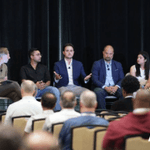
Harvey Nash recently brought together senior architecture leaders from across Yorkshire for an exclusive roundtable in Leeds, exploring one of the biggest challenges facing technology leaders today: how to embrace the opportunities of AI while maintaining control over data, governance and decision-making.
With AI adoption accelerating across organisations, the discussion provided an opportunity for Heads of Architecture, Chief Architects and senior architecture professionals to step away from their day-to-day challenges, share experiences and explore how others are approaching an increasingly complex landscape.
What became clear throughout the conversation was that, while organisations may be at different stages of their AI journeys, many are navigating remarkably similar challenges. And when it comes to finding the right approach, nobody has all the answers.
Finding the balance between AI innovation and control
One of the key themes of the session was the growing tension between accessing the latest AI capabilities and maintaining organisational sovereignty.
As businesses increasingly rely on a small number of major AI providers, questions around data privacy, supplier dependency and long-term control are becoming more pressing.
The group explored what data sovereignty means in practice, from where information is stored and processed to the level of control organisations have over the technology underpinning their operations.
For some, this is prompting a closer look at internally hosted AI solutions.
As one attendee reflected:
"...the overall trajectory around data privacy and processing single points of failures with OpenAI, Anthropic etc. More and more people are starting to think that the end state here is going to be internally hosted LLM's of some sort if the balance between speed, accuracy and cost can be met."
The conversation highlighted that there is no straightforward solution. While internally hosted models could provide greater control, organisations must also consider the implications for cost, performance and scalability.
Ultimately, the challenge is finding the right balance for individual business needs, rather than adopting a single approach to every use case.
AI governance: enabling innovation without creating barriers
Another major discussion point was how organisations can establish effective AI governance without slowing innovation.
With AI tools becoming increasingly accessible, traditional governance processes are being challenged by the speed at which employees and teams can adopt new technologies.
Attendees shared different approaches to managing this, recognising that the level of governance required will often depend on the nature of the work, the sensitivity of the data involved and the organisation's appetite for risk.
One attendee captured this particularly well:
"In terms of AI governance, there is no one size fits all solution. Even within an organisation, governance policies need to be flexible enough to take full advantage of AI where the environment is permissive while enforcing sufficient protection where data is sensitive."
The group also explored how AI is changing software development, with some organisations already moving towards greater automation and reduced human involvement in deployment processes.
This raised wider questions about how engineering responsibilities may evolve, with greater emphasis on solution design, oversight and decision-making.
Rather than focusing solely on controlling AI adoption, the discussion reinforced the importance of creating practical guardrails that allow organisations to innovate confidently and responsibly.
The evolving role of architecture leaders
As AI continues to influence how technology is designed, developed and delivered, the role of architecture is changing too.
The round table provided an opportunity to explore how architecture leaders can position themselves at the centre of this transformation, helping their organisations make informed decisions around technology strategy, governance and risk.
A particularly interesting area of discussion was how architecture teams can continue adding value when AI adoption is happening at pace, sometimes outside traditional approval processes.
The group also discussed the challenge of demonstrating return on investment. While some organisations are already seeing promising results, others are still working out how best to measure the impact of AI initiatives.
As one attendee observed, "many of us have difficulty in predicting and even measuring concrete ROI at this time", despite teams "building novel and promising solutions that would not be possible without AI".
It was a valuable reminder that successful AI adoption isn't simply about implementing the latest technology. It's about making the right decisions for the business, its people and its long-term strategy.
The value of bringing architecture leaders together
Beyond the technical discussions, one of the most valuable aspects of the event was the opportunity for architecture leaders to connect with peers facing similar challenges.
Working in senior architecture roles can often mean navigating complex decisions without many opportunities to openly compare experiences with people outside your own organisation.
By creating a smaller, invite-only environment, the round table encouraged honest discussion, different perspectives and practical knowledge-sharing.
The feedback from attendees reflected the value of that approach, with one describing it as:
"The best architecture meeting I've been to for some considerable time."
Another attendee reflected on the shared challenges facing the profession:
"It is clear no-one is ahead and no-one seems to have the perfect plan of how to go about the change we are subject to at the moment. I think the thing to do now is keep the group together as I think the group will develop and become productive once we get to know each other. I would certainly welcome getting back together."
Continuing the conversation
If there was one clear takeaway from the round table, it was that AI governance and data sovereignty are challenges no organisation can claim to have completely solved.
Technology is evolving quickly, expectations are changing and architecture leaders are playing an increasingly important role in helping businesses navigate what comes next.
Events like this demonstrate the value of creating space for open, honest conversations. Sharing experiences, challenging assumptions and learning from peers can be just as valuable as finding an immediate solution.
At Harvey Nash, we believe bringing people together and creating opportunities for these conversations is an important part of supporting the technology leadership community.
Thank you to everyone who joined us in Leeds and contributed their perspectives. We look forward to continuing the conversation.