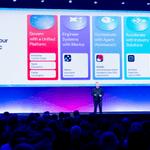
From 4 to 6 August, our Tech Evangelist, David Savage, attended Ai4 in Las Vegas, which brought together more than 12,000 people to explore the latest developments shaping artificial intelligence.
During the event, David moderated a panel on the rise of AI coding assistants, exploring how organisations can use agents to augment software development. He also spoke with several digital leaders for Harvey Nash’s long-running Tech Talks podcast.
While much of the conference focused on deploying AI at scale, David’s conversations raised another question: what happens when organisations actually succeed?
Below, David shares his reflections from the event and the questions technology leaders need to consider as AI moves from experimentation to implementation.
At Ai4, I found myself among a community of people who I would describe as mature in their thinking and understanding of AI.
Ai4 positions itself as North America’s largest AI conference, and more than 12,000 people gathered at the Venetian in Las Vegas to hear from industry leaders, exchange ideas and explore the next phase of AI adoption.
I was invited to moderate a session on the rise of AI coding assistants. The panel brought together engineers, senior technology leaders and security experts to discuss how agents can augment the code being written across many organisations.
Alongside the panel, I sat down with a number of leaders for Harvey Nash’s Tech Talks podcast. Across those conversations, several important themes emerged.
Even AI-mature audiences are still searching for answers
You never really know who will be sitting in the audience at a conference session. Partway through our discussion on AI coding assistants, I asked how many people in the room were software engineers.
Around 95% of the audience raised their hands.
I found that fascinating. I had assumed the session would primarily attract leaders or less technically minded professionals looking to understand how these tools might affect their organisations.
Many of the surveys we have covered on Tech Talks suggest that engineers feel they have a better understanding than their leaders of how to use AI in practice. Yet even within this technically experienced audience, people were looking for insight, reassurance and peer-to-peer support.
Being further along the AI journey does not mean having all the answers.
One question stood out in particular. A teacher asked for the microphone and said: “What should I be teaching my kids?”
It cut through the technical discussion and brought us back to the people who will inherit the decisions organisations are making today.
For all that AI promises, it will not deliver without human oversight. Some organisations that reduced their workforces in anticipation of AI-driven productivity may have moved too far, too quickly. As the technology evolves, there will still be an important place for people. There may be fewer people completing certain tasks, but their judgement, creativity and accountability could become even more instrumental.
Giving the next generation the skills, confidence and sense of purpose to succeed has never been more important.
Define the destination, not just the deployment
At the end of every Tech Talks interview, I ask the same question: “What aren’t we talking about?”
I have been asking it for around a year, and it often makes guests pause. It forces them to look beyond the dominant industry conversations and consider the potential blind spots.
At Ai4, one rather large blind spot quickly came into view.
People want to talk about how to deploy AI at scale. Almost nobody wants to talk about what happens after they succeed.
Erin Boyd, Chief Digital Strategy and AI Officer at The AES Corporation, put it most bluntly:
“I do personally think we are not focusing enough on what happens when we actually successfully deploy agentic AI.”
Organisations are rightly investing time in choosing models, developing agent frameworks and establishing guardrails. But deployment is not the destination.
What does an organisation look like once agentic AI is operating successfully at scale? How do roles, teams and decision-making structures change? Who remains accountable when agents begin completing more business-critical work?
These questions need to be considered before deployment, not after it.
Work backwards from business impact
Stephen Henn, Managing Director of AI Innovation at DLA Piper, approached the conversation from the perspective of return on investment.
He suggested that many organisations begin with the tool and then look for processes or problems to apply it to. Those seeing a genuine return start from the opposite direction:
“What do I want to get out of it? What is the big impact? We know that if we solve this problem, we’re going to get ROI. Then work backwards.”
This distinction is becoming increasingly important. Successful AI implementation does not begin with asking where a new model or agent can be used. It begins with a clearly defined business problem and an understanding of what solving it would achieve.
The technology should follow the outcome.
Without that clarity, organisations risk deploying AI successfully from a technical perspective without creating meaningful business value.
Bring financial accountability into the conversation
Arjun Srinivasan, SVP of AI and Data Science at ShipStation Global, identified another voice that is often missing from discussions around AI deployment:
“I would love to hear more from a CFO’s perspective. They’re the ones who sign the cheque. They’re the ones who are answerable to the board. I’m not hearing that.”
AI strategy cannot remain solely a technology conversation. As investment increases and organisations move from experimentation to scaled deployment, financial leaders need to be part of defining what success looks like, how it will be measured and who will be accountable for delivering it.
The people approving the investment and answering to the board should not enter the conversation only when the costs arrive.
So what happens next?
Ai4 was largely built around the on-ramp to AI adoption. That is not a criticism. Many organisations are still trying to achieve their first meaningful deployment, and there is enormous value in discussing models, frameworks and guardrails.
But very few conversations focused on the destination.
Across different sectors and roles, the same gap appeared repeatedly. Organisations are concentrating on how to deploy AI without giving enough attention to what happens when it works.
What does success actually look like? How will it change the organisation? Who owns the outcome? What role will people continue to play?
If your AI strategy has a clear answer for “how do we deploy?” but a blank space where “what does success look like, and who owns it?” should be, you do not have a deployment problem.
You have a destination problem.
Hear more insights from Ai4 as David’s conversations with digital leaders are released on the Tech Talks podcast.
Watch the video below to hear David’s conversations with digital leaders at Ai4: