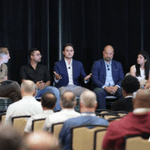
Our Tech Evangelist, David Savage, attended the 2026 ‘One’, OutSystems’ annual conference in Amsterdam, bringing together employees, customers and technology leaders from across the globe to explore the future of digital transformation.
With AI dominating conversations across the technology landscape, the event focused on one critical question: how can organisations move beyond the hype and turn AI innovation into meaningful business impact?
Throughout the conference, David spoke with industry leaders to uncover the key challenges and opportunities facing organisations as they navigate the next phase of AI adoption.
Below, David shares his reflections from the event and the key themes that emerged from those conversations.
In early June, I was invited to attend ‘One’, OutSystems’ annual conference, bringing their employees, customers and tech leaders together in Amsterdam. Threading all the conversations together was one big idea: moving from AI hype to meaningful impact.
Central to fulfilling that ambition was agentic AI. Woodson Martin (CEO of OutSystems) opened proceedings, promising to showcase real AI results from a range of global brands, whilst his colleagues helped attendees explore the latest innovations the OutSystems platform has to offer.
Whilst there, I had the chance to sit down with Woodson, as well as Luis Blando (Chief Product and Technology Officer), and OutSystems’ customer Lucy Donaldson (CIO at Globus). Three clear ideas came through the interviews.
Establish strong governance to prevent "shadow AI" and technical debt
As AI technology accelerates, Luis Blando told us leaders face the “terrible” tension present between rapid innovation and the need to maintain control and safety. Experimenting with disparate AI tools, without a cohesive platform approach, is creating a mountain of technical debt and compliance risks for enterprises.
The accessibility of AI empowers employees to solve problems on their own, leading to the growth of shadow AI. To avoid repeating past mistakes, technology leaders have to shift their roles to become more governance-led.
Optimise AI costs by matching the right model to the specific use case
It’s a message that is not new, but the power of AI highlights why ‘use the right tool’ needs repeating. The financial impact of widespread AI adoption is becoming a major concern for the C-suite, culminating in what is being described by some as a "token-o-palypse" (or tokenomics). Advanced models that loop through reasoning steps are burning through tokens, leading to massive and unexpected expenses.
Tech and digital leaders must recognise that they do not always need a Ferrari to solve every problem, when a bicycle is often perfectly adequate. For up to 90% of daily enterprise workloads, such as basic sentiment analysis, leaders should build systems with the flexibility to swap in smaller or open-source models at a fraction of the cost.
Prioritise cultural transformation and foundational data management
Organisations are rethinking their workflows and roles whilst AI agents begin completing tasks. But integrating AI effectively is fundamentally about people and data, not the tool. Adopting agentic AI systems requires a cultural transformation.
Bringing established teams along on this journey and shifting organisational dialogue requires dedicated leadership and can benefit from a beginner's mindset, where decisions are fully discussed and understood. Underpinning this cultural shift must be a rigorous focus on data. AI implementation will fail without proper context, making a master data management journey the essential first stepping stone for any AI strategy.
So what happens next?
Heading for the airport, I couldn’t help but reflect on the conversations I’d heard. Not just the interviews I conducted but the chats with vendors at their stations. Providers of AI are acutely aware that the products they are selling are leading to complex challenges, both structural and cultural. They themselves are urging organisations to slow down, to scale back on broad experimentation. But after three years of feeling like they’re falling behind, most companies aren’t ready to heed those warnings.
The irony is that the people selling the Ferrari are the ones telling you to take the bus. Until the bills arrive, nobody's listening.
Hear more from the event as David shares his conversations with digital leaders on the ground at OutSystems’ One conference via the video below