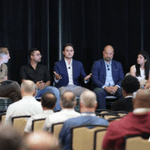
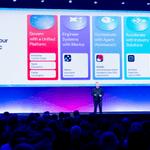
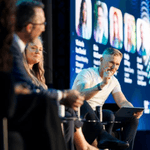
At Web Summit Vancouver last month, Tech Evangelist David Savage spent time speaking with leaders, practitioners, and students across the tech ecosystem, exploring how AI is reshaping work, leadership, and creativity.
Across conversations on the floor and on stage, a set of recurring questions emerged on whether fears around AI-driven job displacement are justified or a failure of imagination, whether leaders are truly keeping pace with the technology they are expected to guide, and what the rise of machine-generated content means for human creativity and connection.
In this piece, David explores a series of overlapping tensions that emerged from his time in Vancouver. Rather than presenting a single clear narrative, he reflects on the questions and contradictions that continue to shape the debate around AI’s impact on work, leadership, and society
Is the fear of AI job creep justified, or showing a lack of imagination?
Are leaders able to keep up with the challenges presented by AI, and if not, what does that mean for people further down the career ladder?
AI is creating hyper-realistic content at a staggering scale, but is the human void at its heart pushing us closer together?
These are just three questions I left Vancouver pondering following my time at Web Summit last month.
I spoke to leaders, guests, and students across the floor, on the stages, and huddled around meeting room tables, and these ideas were simply inescapable. The same concerns surfaced again and again, in different accents, different industries, different contexts, but circling the same anxious orbit.
The co-pilot in the room
Let's start with the fear. Because there is genuine fear out there (and it would be dishonest to dismiss it out of hand). But a striking number of the people I spoke to in Vancouver weren't just pushing back on the panic; they were frustrated by it.
Nick Muy of Scrut Automation was blunt about it. He argued that the idea that AI will simply eliminate jobs represents a fundamental “lack of imagination”. History is on his side; new technology has consistently led to task expansion. More work, not less. The narrative of mass redundancy ignores the pattern we've seen play out with every major technological shift.
Eric Wittman of VSCO made the same point from a creative angle. The fear that AI will replace photographers, he told me, misunderstands what AI actually does in practice. His experience is that it functions as a vital assistant, helping creatives cull hundreds of photos in a fraction of the time. It shoulders the administrative burden of running a creative business. It doesn't replace the eye. It clears the path for it.
It’s clear leaders are positive about how AI can increase the capabilities of their people. Realta Fusion’s Cary Forest described using generative AI as a scientific collaborator, a tool that helped him solve complex calculus and algebra problems in minutes that would previously have taken months. Cary believes AI is accelerating, not replacing humans. Avery Pennarun from Tailscale framed it as an equaliser. AI helps everyone level up, turning non-coders into coders, junior developers into seniors, and multiplying the output of those already operating at the top of their game.
I got the overwhelming impression that those I spoke to felt that human problem-solving would stay at the core of work. The machine just does the warm-up work.
The leaders who can't keep up
If AI is accelerating everything, what happens when the people leading us through that acceleration struggle to keep up?
This came up repeatedly, and it wasn't comfortable. The consensus was that leaders no longer have the luxury of delegating their understanding of AI to someone else in the organisation.
Nancy Wang, CTO of 1Password, put it clearly. The role of CTOs and CISOs has fundamentally shifted from compliance-focused or background technical roles to becoming the face of AI transformation. That's a significant change, and not every leader has made the adjustment. At 1Password, the shift is visible even in how they hire. Traditional coding tests have been replaced. Candidates are now evaluated on how well they can instruct and debug alongside an AI coding agent.
Eric Wittman was equally direct: leaders need to lead from the front. Not brief on AI, but actually use it, test it, break it. The skills that got you to your current position are worth scrutinising. The organisations whose leaders are engaged hands-on are the ones building faster. Nick Muy echoed this. AI, he said, gives tech leaders no excuse not to be doing it themselves. The tools are accessible. The opportunity to stay close to the build is there. The question is whether leaders have the appetite to take it.
And for those further down the career ladder? If leaders are struggling to keep up, the implications cascade. Brian Tanner of Artificial Agency offered a more optimistic lens here. He sees AI agents becoming interactive coaches, helping people build skills in everything from public speaking to customer service in real-world settings. The classroom, in other words, may increasingly look less like a classroom. This is timely, especially given the suspicion that the value of a traditional four-year degree has dramatically fallen.
The human hunger underneath it all
The more people talked about AI's capacity to generate content at scale, the more another theme emerged. A hunger for things that feel unmistakably human.
Myles Palmer, of Metalab raised what he called the question of trust in the age of AI. Because AI can generate a convincing digital experience in minutes, he argued that consumers are now searching for that extra 10 to 15 per cent of human care and craft, or perhaps the unmistakable signs that something is a little less polished and real. Myles also called out the psychological exhaustion of using AI to process unsustainable volumes of work. We are asking human beings to keep pace with machine-speed throughput, and there are limits. If anything, it’s dangerous as we sacrifice critical thinking just to keep up.
Brian Tanner's work at Artificial Agency is a fascinating response to this tension. The future of AI in entertainment (they’re in gaming) isn't about making bigger worlds, it's about making deeper ones. He's focused on replicating the social dynamics of playing board games with friends; characters that hold grudges, form political alliances, and create experiences with genuine emotional weight and memory.
Nancy Wang approached the human question from the security side. As we delegate more tasks to AI agents, the challenge of managing the identities and credentials those agents use (the trust access gap) becomes critical. Who is acting on your behalf, and how do you know?
So what did I walk away from Vancouver with? Answers? No, but a much sharper set of questions and a renewed sense that the people worth listening to are the ones who are sitting with the complexity rather than attempting to downplay it.
To hear these perspectives first-hand, watch our on-the-ground video from Web Summit Vancouver, where David Savage explores the realities of AI-driven change, the pressures on leadership to keep pace, and what rising machine capability means for work, creativity, and human value.